
Godkomplex has spent nearly three decades doing the opposite, protecting a sound instead of chasing whatever happens to be popular. Formed in 1998 by Mr. Panik and Download, the duo built the project specifically to revitalize hard industrial music at a moment when the genre risked fading into nostalgia. Their newest single, "Club Crawlers," proves that mission hasn't softened with age.
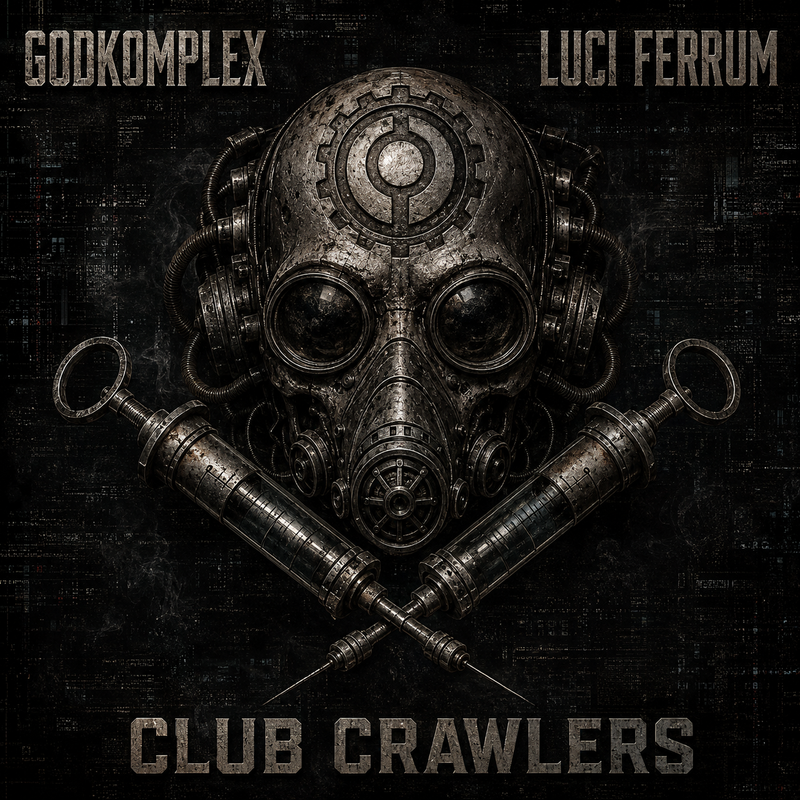
The track pulls from the same well Godkomplex has drawn from since the beginning: drum & bass, power noise, techno, trance, and coldwave, fused into something that carries the weight and aggression of early industrial while sounding unmistakably built for right now. "Club Crawlers" leans into that tension directly, aiming squarely at the dancefloor without sanding down the genre's harder, colder edges to get there. It's industrial music that refuses to apologize for either half of its identity.
That authenticity comes from genuine pedigree, not a manufactured costume. Download has been embedded in industrial music since the mid-1980s, cutting his teeth in Servo Sector alongside members who later shaped Kevorkian Death Cycle and Hex RX. Mr. Panik continues working across side projects including Chaos Frequency and Skinprobe, keeping his ear tuned closely to where the genre is actually heading rather than where it's already been.
Godkomplex's catalogue reflects that same long view stretched across decades. Their debut album, "World Below," arrived in January 2000 and later found wider national distribution through a 2003 re-release. "Audial Apostasy," their second full-length record, landed on the symbolically loaded date of June 6, 2006, expanding the lineup with new members Reload and the Loch Ness Monster. More recently, the band has released a steady, deliberate run of digital singles, "Torture," "Race-4-Power," "Satanica," and a remixed version of "Kill For God," each one building momentum toward a highly anticipated late-2026 vinyl "Best Of" collection spanning a full twenty-five years of material.
"Club Crawlers" fits naturally into that arc, not a reinvention but a continuation, proof that a genre built on darkness and repetition can still evolve without losing what made it dangerous in the first place. For listeners who found industrial decades ago, and for anyone just discovering it now, Godkomplex offers something increasingly rare in modern electronic music: a band still playing the long game, one relentless track at a time, unwilling to let a genre's history simply fade quietly into archival footnotes.